INSURANCE
ORANGE COUNTY, ORANGE COUNTY INSURANCE, INSURANCE QUOTE ORANGE
COUNTY CALIFORNIA, Auto Insurance, Home Insurance, Commercial
Property Insurance, Fleet Insurance, Commercial Auto Insurance,
Professional Liability Insurance, Directors and Officers Umbrella
Insurance, Bonding (Fidelity/Surety) Insurance, Air and Ocean
Cargo Insurance, Inland Marine InsuranceCommercial Liability
Insurance, Boat, Yacht Insurance, Builder's Risk Insurance,
Boiler and Machinery Insurance, Commercial Packages Insurance,
Workers' Compensation Insurance
FREE
INSURANCE ESTIMATES -Call Today
(949) 581-2333
Friendly Knowledgeable Insurance Agents, Full Service, Mulit-Line
Agency
"Many
Times We Insure and Save Where Others Don't Have The Knowledge."
- Ed Aylor
The
Hartford, Travelers, Encompass, Mercury, Progressive, First
American Corporation, Old Republic, CU Insurance, CNA and
Many More...
Insurance
Orange County .com
"Voted
Best Insurance
Agency in Orange County"
FREE
INSURANCE
ESTIMATES
Aylor
Insurance Agency, Inc. "Knowledge
is Protection"
Aylor Insurance Agency, Inc.
CA Lic. #: 0747430 22691 Lambert
Street, Suite 505
Lake Forest , CA 92630
CALL US TODAY
(949) 581-2333
To
Text Us: "Click Here"
Ed Aylor is founder and President of Aylor Insurance
Agency, Inc. He has truly set a standard for professional
and ethical insurance operations in Orange County. Respected
and liked by his customers, colleagues and even competitors,
Ed is insistent that Aylor Insurance maintain its high standards
and provide quality service
NOTE:
The information
and notices contained on this website are intended as
general research and information and are expressly not
intended, and should not be regarded, as medical, financial
or legal advice. The articles are from free sources
Important Note: This website provides only a
simplified description of coverages and is not a statement
of contract. Coverage may not apply in all states. For
complete details of coverages, conditions, limits and
losses not covered, be sure to read the policy, including
all endorsements. .
"Fun
is like life insurance; the older you get, the more
it costs." Kin Hubbard
"Worry
often gives a small thing a big shadow. - Swedish Proverb"
"Honesty
is something you can't wear out. --Waylon Jennings quotes
(American Musician, b.1937)"
Truth
is more valuable than flattery. "In the end, people
appreciate frankness more than flattery." Proverbs 28:23
.
Welcome
To: Insurance
Orange County
Aylor Insurance Agency, Inc. "Voted
Best in Insurance Knowledge"
Get the Coverage You need
for Your Business and Personal! FREE
INSURANCE ESTIMATES
We at Aylor Insurance
Agency, Inc., are all about serving you!
We deal with complex to simple insurance questions
and issues.
Our staff is committed to learning about you;
knowing your needs; finding out your desires;
and serving you in every way we can.
We want you to get to know us, and to feel good
about contacting us and telling us every way we
can provide help or service to you!
Aylor
Insurance Agency, Inc.
Provides Quality Insurance for You
and/or Your Business
CALL
US TODAY (949)
581-2333
Three
ways Aylor Insurance Agency, Inc. Can
Help You!
Personal
Insurance
And
Hard To Find Insurance
Automobile Insurance
Builders Risk Insurance
Farm and Ranch Insurance
Homeowners Insurance
Fine Arts Insurance
Furs Insurance
Jewelry Insurance
Mobilehomes Insurance
Motorcycles Insurance
Personal Liability Insurance
Personal Umbrella Insurance
Personal Watercraft Insurance
Recreational Vehicles Insurance
Renters Insurance
Tenant Dwellings Insurance
Earthquake Insurance
Commercial,
Industrial and Business Insurance
Commercial Property Insurance
Commercial Auto Insurance
Professional Liability Insurance
Directors and Officers Umbrella
Insurance
Bonding (Fidelity/Surety) Insurance
Air and Ocean Cargo Insurance
Inland Marine Insurance
Commercial Liability Insurance
Boat/Yacht Insurance
Builder's Risk Insurance
Boiler and Machinery Insurance
Commercial Packages Insurance
Workers' Compensation Insurance
Flood Insurance
Small, Medium, Large Business
Insurance
Financial
Insurance, Business Services
Life Insurance
Term Life Insurance
Whole Life Insurance
Universal Life Insurance
Mortgage Protection Insurance
Estate Liquidity Insurance
Health Insurance
Individual Health Insurance
HSA's Insurance
Employee Group Benefits Insurance
Dental Insurance
Long Term Care Insurance
Nursing Home Insurance
Home Health Insurance
Assisted Living Care Insurance
Supplemental
Insurance
Accident Insurance
Cancer Insurance
Intensive Care Insurance
Catastrophic Illness Insurance
Disability Income Insurance
Retirement Planning
Annuities
IRA Plans
-- Traditional IRAs
-- Roth IRAs
Capital Needs Analysis
Corporate
& Business Services
Pension Plans
401K / Other Retirement
Buy/Sell Funding
Key-Person Insurance
Split Dollar Insurance
Reverse Split Dollar Insurance
Salary Continuation Insurance
Getting
the right insurance in a timely manner
can be as easy as 1, 2, 3.
Contact us now to discuss the options
right for you.
REVIEWS
& Testimonials: What People
are Saying About Aylor Insurance Agency,
Inc....
"WOW
I SAVED 1/3 ON INSURANCE!"
"Wow,
I saved 1/3 the rate I was paying on my
commercial insurance. Instead of paying
25K per year we now pay 15K. I was very
impressed with how much Aylor Insurance
knows to make it happen. Eric - San Clemente"
"EXPECTATIONS
EXCEEDED!"
"Its
nice to have your expectations in a business
not only met but exceeded! Buying Life
Insurance with you was professional, friendly
& effective. Ed you really help me and
my wife understand all the details and
how life insurance works...many thanks
for your efforts which allowed us to get
the exact coverage we needed." John -
Irvine
"LOWERED
MY WORKERS COMP!"
"I
was despirate to get my workers compensation
down for my construction business. I was
truly amazed at how much you knew about
lowering my insurance costs and increasing
my coverage. Just the little thing you
showed me made such a difference. I always
find it amazing how knowledge is power."
Jeff - San Francisco
Any
Questions? Please give us a call:(949)
581-2333
Independence
is the Key
We can find you the best coverage because
we have a plethora of companies and
policies to choose from. We are not
tied to a specific company but represent
a large variety. Because we are insurance
pros and have the knowledge of these
companies strengths as well as the ability
to match your needs to those strengths,
we can find you the best coverage at
the right price.
What
Should You Have?
Having the right coverage is important.
We work with you to determine both your
needs and desires. We advise you per
possible circumstances. We match your
needs and budget to the best supplier
and make a match that will provide you
the best coverage that you can get.
DO
YOU HAVE A QUESTIONS ON INSURANCE?
CALL US TODAY (949)
581-2333
We
Represent Many of the Below Insurance
Companies:
LIST
OF US INSURANCE COMPANIES
* American National Insurance Company
* American Automobile Association
* AIG
* Allstate
* American Family Insurance
* American Farmers and Ranchers Mutual
(formerly Oklahoma Farmers Union Mutual)
* Amica
* Auto-Owners Insurance
* California Casualty Insurance
* CapitalOne
* Commerce Insurance Group
* COUNTRY Insurance & Financial Services
* Cuna Mutual Group
* Electric Insurance Company
* Esurance
* Expatriate Insurance
* Farm Bureau Insurance
* Farmers Insurance
* Frankenmuth Mutual Insurance Company
* GAINSCO Auto Insurance
* GMAC Insurance
* Geico
* The General
* GuideOne
* Hanover Insurance
* The Hartford
* Hastings Mutual Insurance Company
* Haulers Insurance Company
* Infinity Auto Insurance Company
* Liberty Mutual
* Nationwide Insurance
* National Interstate
* Metropolitan Life Insurance Company
* Mutual of Enumclaw
* OneBeacon Insurance Group
* Pekin Insurance
* Pemco
* Progressive
* Safeco
* Safeway Insurance Group
* Standard Insurance Company
* State Auto Insurance Companies
* Shelter Insurance Companies
* Solid Insurance Group
* Mutual Automobile Insurance
Company
* The St. Paul Travelers Companies, Inc.
* Trustgard Insurance
* Unitrin Direct Auto Insurance
* USAA
* Wawanesa (California)
* Westfield Insurance
LIST
OF DISABILITY INSURANCE COMPANIES
* American Family Insurance * Mutual of
America * Principal Financial Group *
Standard Insurance Company * Unum * Berkshire
Life * MetLife
LIST
OF EXPATRIATE INSURANCE COMPANIES:
* Clements International
LIST
OF GENERAL LIABILITY INSURANCE COMPANIES:
*
American Family Insurance
LIST
OF HEALTH INSURANCE COMPANIES:
*
American National Insurance Company *
Aetna * Aflac * American Family Insurance
* American Medical Security Life Insurance
Company * Anthem * Assurant * Asuris Northwest
Health * Blue Cross and Blue Shield Association
* Celtic Insurance Co. * CIGNA * community
first * Continental General * Fortis *
Golden Rule Insurance Company * Group
Health Inc. * Group Health Cooperative
* Harvard Community Health Plan * HealthMarkets
* Health Net of Arizona * Health Net of
Oregon * HealthPartners * Health Plan
of Nevada * Humana Inc. * Insurance Services
of America * Intermountain Health Care
* Kaiser Permanente * LifeWise Health
Plan of Arizona * LifeWise Health Plan
of Oregon * LifeWise Health Plan of Washington
* Medica of Minnesota * Medical Mutual
* Oxford Health Plans, Inc. * Principal
Financial Group * Shelter Insurance Companies
* UNICARE * UnitedHealthCare (UnitedHealth
recently purchased Pacificare) * Vista
Healthplan of South Florida * Wellpoint
* College Health IPA * Acordia National
LIST
OF LIFE INSURANCE COMPANIES: *
AAA d.b.a. Western United * AAA Life Insurance
Company * Aetna * AIG American General
* Alfa Life Insurance * Allstate Insurance
Company * American Family Insurance *
American Farmers and Ranchers * American
International Group * American National
Insurance Company * Aon Corporation, formerly
known as Combined Insurance Company of
America * Auto-Owners Insurance * AXA
* Bankers Life and Casualty Company *
Banner Life * The Chesapeake Life Insurance
Company * Farm Bureau Insurance * Farmers
Insurance * First United American Life
Insurance Company * Foresters * Garden
State Life Insurance Company * Globe Life
And Accident Insurance Company * Guardian
Life Insurance Company * Jackson National
Life * John Hancock Insurance, now a unit
of Manulife Financial * The Hartford *
Kansas City Life Insurance Company, Inc.
* Lafayette Life Insurance Company * Liberty
NationalLife Insurance Company * Mass
Mutual Financial Group * MEGA Life and
Health Insurance * Metropolitan Life Insurance
Company * Minnesota Life Insurance Company
* Modern Woodmen of America * Nationwide
Insurance * New York Life * Northwestern
Mutual Life Insurance Company * Old Mutual
* Pacific Life Insurance * Primerica Life
Insurance Company * Principal Financial
Group * Protective Life Corporation *
Prudential Financial * RBC * Sagicor USA,
Inc., formerly known as American Founders
Life * Shenendoah * The Standard (Also
known as Standard Insurance Company) *
Shelter Life Insurance Company * Insurance * Thrivent Financial for
Lutherans, product of merger between Lutheran
Brotherhood & Aid Association for Lutherans
* Travelers Group, now somewhat part of
Citigroup, other parts belong to The St.
Paul Travelers Companies, Inc. * USAA
* West Coast * Western & Southern * Western
Reserve Life
LIST
OF PET INSURANCE COMPANIES: *
ASPCA Pet Health Insurance * Pets Health
Plan * Hartville Pet Insurance * PetCare
* Global Pet Insurance * Pets Best Pet
Insurance * Veterinary Pet Insurance *
Embrace Pet Insurance * Petplan USA Pet
Insurance * PetFirst Healthcare Pet Insurance
* Trupanion Pet Health Insurance
LIST
OF PROPERTY AND CASUALTY INSURANCE COMPANIES:
* ACE USA * Acuity * Allstate
* Alfa Mutual Insurance * American Family
Insurance * American National Property
and Casualty * American International
Group * Assurant Specialty Property *
Argonaut Group, Inc. * Auto-Owners Insurance
* BISYS Commercial Insurance Services,
Inc. * Bliss & Glennon, Inc. * Chubb Corporation
* Church Mutual * Cincinnati Financial
Corporation * Commerce Insurance Group
* CNA Financial Corporation * Farm Bureau
Insurance * Farmers Insurance * Fireman's
Fund Insurance Company * FM Global * Frankenmuth
Mutual Insurance Company * Great American
Insurance Company * Hanover Insurance
* The Hartford * Hastings Mutual Insurance
Company * Harleysville Insurance Company
* HomeInsurance.com * Infinity Property
& Casualty * Liberty Mutual * Manulife
Financial * Markel Corporation * Nationwide
Insurance * NLC Insurance Companies *
OneBeacon Insurance Group * Penn National
Insurance * Philadelphia Insurance * The
St. Paul Travelers Companies, Inc. * Safeway
Insurance Group * Secura * Sentry Insurance
* Shelter Insurance Companies * State
Auto Insurance Companies *
Insurance * Southern Farm Bureau * Union
Standard Insurance * United Automobile
Insurance Company * USAA * Wausau Insurance
Companies * West Bend Mutual Insurance
Company * Westfield Insurance * Zenith
Insurance Company * Zurich Insurance Services
* Island Insurance * The Phoenix Group
LIST
OF RENTER INSURANCE COMPANIES: *
American Family Insurance * American Bankers
Insurance Company of Florida * Assurant
Specialty Property * Balboa Insurance
* Insurance
LIST
OF TRAVEL INSURANCE COMPANIES: *
American Family Insurance * ASSIST-CARD
LIST
OF WORKERS' COMPENSATION INSURANCE COMPANIES:
* ACE * Amerisafe * Liberty
Mutual * Missouri Employers Mutual * Penn
National Insurance * State Accident Insurance
Fund (Oregon) * State Compensation Insurance
Fund (California) * Zenith Insurance
PICTURES
FROM Aylor Insurance Agency, Inc. If the below show pictures are not
coming up please "click here"
Report
A Claim
Reporting A Claim
If you have a claim, or if you believe you may
have a claim, please call our office immediately.
Please see our contact information throughout
this webpage or call us at (949) 581-2333. We
will assist you in every way at our disposal.
In the event you need to file a claim outside
normal business hours and you are unable to
reach our office, the carriers listed below
offer 24 hour direct claim reporting services.
You may also report a claim on-line if your
carrier has a web link below. Before calling,
please be sure to have your policy number and
claim details available. After your claim is
filed, the insurance carrier will forward a
copy of your claim report to our office. If
your carrier is not listed below, please refer
to your policy for an 800# direct claim filing
number or call our office at your earliest possible
opportunity at (949) 581-2333.
Insurance
is the equitable transfer of the risk
of a loss, from one entity to another
in exchange for payment. It is a form
of risk management
primarily used to hedge
against the risk of a contingent, uncertain
loss.
An
insurer, or insurance carrier, is a company
selling the insurance; the insured, or
policyholder, is the person or entity
buying the insurance policy. The amount
of money to be charged
for a certain amount of insurance coverage
is called the premium. Risk
management, the practice of appraising
and controlling risk, has evolved as a
discrete field of study and practice.
The
transaction involves the insured assuming
a guaranteed and known relatively small
loss in the form of payment to the insurer
in exchange for the insurer's promise
to compensate (indemnify)
the insured in the case of a financial
(personal) loss. The insured receives
a contract, called
the insurance
policy, which details the conditions
and circumstances under which the insured
will be financially compensated.
Principles
Insurance
involves pooling
funds from many insured entities
(known as exposures) to pay for the losses
that some may incur. The insured entities
are therefore protected from risk for
a fee, with the fee being dependent upon
the frequency and severity of the event
occurring. In order to be an insurable
risk, the risk insured against must
meet certain characteristics. Insurance
as a financial intermediary is a commercial
enterprise and a major part of the financial
services industry, but individual entities
can also self-insure
through saving money for possible future
losses.
Risk
which can be insured by private companies
typically shares seven common characteristics:
Large
number of similar exposure units:
Since insurance operates through pooling
resources, the majority of insurance
policies are provided for individual
members of large classes, allowing insurers
to benefit from the law
of large numbers in which predicted
losses are similar to the actual losses.
Exceptions include Lloyd's
of London, which is famous for insuring
the life or health of actors, sports
figures, and other famous individuals.
However, all exposures will have particular
differences, which may lead to different
premium rates.
Definite
loss: The loss takes place at a
known time, in a known place, and from
a known cause. The classic example is
death of an insured person on a life
insurance policy. Fire,
automobile
accidents, and worker injuries may
all easily meet this criterion. Other
types of losses may only be definite
in theory. Occupational
disease, for instance, may involve
prolonged exposure to injurious conditions
where no specific time, place, or cause
is identifiable. Ideally, the time,
place, and cause of a loss should be
clear enough that a reasonable person,
with sufficient information, could objectively
verify all three elements.
Accidental
loss: The event that constitutes
the trigger of a claim should be fortuitous,
or at least outside the control of the
beneficiary of the insurance. The loss
should be pure, in the sense that it
results from an event for which there
is only the opportunity for cost. Events
that contain speculative elements, such
as ordinary business risks or even purchasing
a lottery ticket, are generally not
considered insurable.
Large
loss: The size of the loss must
be meaningful from the perspective of
the insured. Insurance premiums need
to cover both the expected cost of losses,
plus the cost of issuing and administering
the policy, adjusting losses, and supplying
the capital needed to reasonably assure
that the insurer will be able to pay
claims. For small losses, these latter
costs may be several times the size
of the expected cost of losses. There
is hardly any point in paying such costs
unless the protection offered has real
value to a buyer.
Affordable
premium: If the likelihood of an
insured event is so high, or the cost
of the event so large, that the resulting
premium is large relative to the amount
of protection offered, then it is not
likely that the insurance will be purchased,
even if on offer. Furthermore, as the
accounting profession formally recognizes
in financial accounting standards, the
premium cannot be so large that there
is not a reasonable chance of a significant
loss to the insurer. If there is no
such chance of loss, then the transaction
may have the form of insurance, but
not the substance. (See the US Financial
Accounting Standards Boardstandard
number 113)
Calculable
loss: There are two elements that
must be at least estimable, if not formally
calculable: the probability of loss,
and the attendant cost. Probability
of loss is generally an empirical exercise,
while cost has more to do with the ability
of a reasonable person in possession
of a copy of the insurance policy and
a proof of loss associated with a claim
presented under that policy to make
a reasonably definite and objective
evaluation of the amount of the loss
recoverable as a result of the claim.
Limited
risk of catastrophically large losses:
Insurable losses are ideally independent
and non-catastrophic, meaning that the
losses do not happen all at once and
individual losses are not severe enough
to bankrupt the insurer; insurers may
prefer to limit their exposure to a
loss from a single event to some small
portion of their capital base. Capital
constrains insurers' ability to sell
earthquake
insurance as well as wind insurance
in hurricane
zones. In the US, flood
risk is insured by the federal government.
In commercial fire insurance, it is
possible to find single properties whose
total exposed value is well in excess
of any individual insurer's capital
constraint. Such properties are generally
shared among several insurers, or are
insured by a single insurer who syndicates
the risk into the reinsurance
market.
Legal
When
a company insures an individual entity,
there are basic legal requirements. Several
commonly cited legal principles of insurance
include:
Indemnity
- the insurance company indemnifies,
or compensates, the insured in the case
of certain losses only up to the insured's
interest.
Insurable
interest - the insured typically
must directly suffer from the loss.
Insurable interest must exist whether
property insurance or insurance on a
person is involved. The concept requires
that the insured have a "stake" in the
loss or damage to the life or property
insured. What that "stake" is will be
determined by the kind of insurance
involved and the nature of the property
ownership or relationship between the
persons. The requirement of an insurable
interest is what distinguishes insurance
from gambling.
Contribution
- insurers which have similar obligations
to the insured contribute in the indemnification,
according to some method.
Subrogation
- the insurance company acquires legal
rights to pursue recoveries on behalf
of the insured; for example, the insurer
may sue those liable for the insured's
loss.
Causa
proxima, or proximate
cause - the cause of loss (the peril)
must be covered under the insuring agreement
of the policy, and the dominant cause
must not be excluded
Mitigation
- In case of any loss or casualty, the
asset owner must attempt to keep loss
to a minimum, as if the asset was not
insured.
To
"indemnify" means to make whole again,
or to be reinstated to the position that
one was in, to the extent possible, prior
to the happening of a specified event
or peril. Accordingly, life
insurance is generally not considered
to be indemnity insurance, but rather
"contingent" insurance (i.e., a claim
arises on the occurrence of a specified
event). There are generally three types
of insurance contracts that seek to indemnify
an insured:
a
"reimbursement" policy, and
a
"pay on behalf" or "on behalf of" policy,
and
an
"indemnification" policy.
From
an insured's standpoint, the result is
usually the same: the insurer pays the
loss and claims expenses.
If
the Insured has a "reimbursement" policy,
the insured can be required to pay for
a loss and then be "reimbursed" by the
insurance carrier for the loss and out
of pocket costs including, with the permission
of the insurer, claim expenses.
Under
a "pay on behalf" policy, the insurance
carrier would defend and pay a claim on
behalf of the insured who would not be
out of pocket for anything. Most modern
liability insurance is written on the
basis of "pay on behalf" language which
enables the insurance carrier to manage
and control the claim.
Under
an "indemnification" policy, the insurance
carrier can generally either "reimburse"
or "pay on behalf of", whichever is more
beneficial to it and the insured in the
claim handling process.
An
entity seeking to transfer risk (an individual,
corporation, or association of any type,
etc.) becomes the 'insured' party once
risk is assumed by an 'insurer', the insuring
party, by means of a contract,
called an insurance
policy. Generally, an insurance contract
includes, at a minimum, the following
elements: identification of participating
parties (the insurer, the insured, the
beneficiaries), the premium, the period
of coverage, the particular loss event
covered, the amount of coverage (i.e.,
the amount to be paid to the insured or
beneficiary in the event of a loss), and
exclusions
(events not covered). An insured is thus
said to be "indemnified"
against the loss covered in the policy.
When
insured parties experience a loss for
a specified peril, the coverage entitles
the policyholder to make a claim against
the insurer for the covered amount of
loss as specified by the policy. The fee
paid by the insured to the insurer for
assuming the risk is called the premium.
Insurance premiums from many insureds
are used to fund accounts reserved for
later payment of claims - in theory for
a relatively few claimants - and for overhead
costs. So long as an insurer maintains
adequate funds set aside for anticipated
losses (called reserves), the remaining
margin is an insurer's profit.
Societal
effects
Insurance
can have various effects on society through
the way that it changes who bears the
cost of losses and damage. On one hand
it can increase fraud; on the other it
can help societies and individuals prepare
for catastrophes and mitigate the effects
of catastrophes on both households and
societies.
Insurance
can influence the probability of losses
through moral
hazard, insurance
fraud, and preventive steps by the
insurance company. Insurance scholars
have typically used morale
hazard to refer to the increased loss
due to unintentional carelessness and
moral hazard to refer to increased risk
due to intentional carelessness or indifference.
Insurers attempt to address carelessness
through inspections, policy provisions
requiring certain types of maintenance,
and possible discounts for loss mitigation
efforts. While in theory insurers could
encourage investment in loss reduction,
some commentators have argued that in
practice insurers had historically not
aggressively pursued loss control measures-particularly
to prevent disaster losses such as hurricanes-because
of concerns over rate reductions and legal
battles. However, since about 1996 insurers
have begun to take a more active role
in loss mitigation, such as through building
codes.
Insurers'
business model
Underwriting
and investing
The
business model is to collect more in premium
and investment income than is paid out
in losses, and to also offer a competitive
price which consumers will accept. Profit
can be reduced to a simple equation:
Profit
= earned
premium + investment income - incurred
loss - underwriting expenses.
Insurers
make money in two ways:
Through
underwriting,
the process by which insurers select
the risks to insure and decide how much
in premiums to charge for accepting
those risks;
By
investing
the premiums they collect from insured
parties.
The
most complicated aspect of the insurance
business is the actuarial
science of ratemaking (price-setting)
of policies, which uses statistics
and probability
to approximate the rate of future claims
based on a given risk. After producing
rates, the insurer will use discretion
to reject or accept risks through the
underwriting process.
At
the most basic level, initial ratemaking
involves looking at the frequency
and severity
of insured perils and the expected average
payout resulting from these perils. Thereafter
an insurance company will collect historical
loss data, bring the loss data to present
value, and compare these prior losses
to the premium collected in order to assess
rate adequacy. Loss
ratios and expense loads are also
used. Rating for different risk characteristics
involves at the most basic level comparing
the losses with "loss relativities" -
a policy with twice as many losses would
therefore be charged twice as much. More
complex multivariate
analyses are sometimes used when multiple
characteristics are involved and a univariate
analysis could produce confounded results.
Other statistical methods may be used
in assessing the probability of future
losses.
Upon
termination of a given policy, the amount
of premium collected minus the amount
paid out in claims is the insurer's underwriting
profit on that policy. Underwriting
performance is measured by something called
the "combined ratio" which is the ratio
of expenses/losses to premiums. A combined
ratio of less than 100 percent indicates
an underwriting profit, while anything
over 100 indicates an underwriting loss.
A company with a combined ratio over 100%
may nevertheless remain profitable due
to investment earnings.
Insurance
companies earn investment
profits on "float". Float, or available
reserve, is the amount of money on hand
at any given moment that an insurer has
collected in insurance premiums but has
not paid out in claims. Insurers start
investing insurance premiums as soon as
they are collected and continue to earn
interest or other income on them until
claims are paid out. The Association
of British Insurers (gathering 400
insurance companies and 94% of UK insurance
services) has almost 20% of the investments
in the London
Stock Exchange.
In
the United States,
the underwriting loss of property
and casualty
insurance companies was $142.3 billion
in the five years ending 2003. But overall
profit for the same period was $68.4 billion,
as the result of float. Some insurance
industry insiders, most notably Hank
Greenberg, do not believe that it
is forever possible to sustain a profit
from float without an underwriting profit
as well, but this opinion is not universally
held.
Naturally,
the float method is difficult to carry
out in an economically
depressed period. Bear
markets do cause insurers to shift
away from investments and to toughen up
their underwriting standards, so a poor
economy generally means high insurance
premiums. This tendency to swing between
profitable and unprofitable periods over
time is commonly known as the underwriting,
or insurance, cycle.
Claims
Claims
and loss handling is the materialized
utility of insurance; it is the actual
"product" paid for. Claims may be filed
by insureds directly with the insurer
or through brokers
or agents. The insurer may require
that the claim be filed on its own proprietary
forms, or may accept claims on a standard
industry form, such as those produced
by ACORD.
Insurance
company claims departments employ a large
number of claims
adjusters supported by a staff of
records
management and data
entry clerks. Incoming claims are
classified based on severity and are assigned
to adjusters whose settlement authority
varies with their knowledge and experience.
The adjuster undertakes an investigation
of each claim, usually in close cooperation
with the insured, determines if coverage
is available under the terms of the insurance
contract, and if so, the reasonable monetary
value of the claim, and authorizes payment.
The
policyholder may hire their own public
adjuster to negotiate the settlement
with the insurance company on their behalf.
For policies that are complicated, where
claims may be complex, the insured may
take out a separate insurance policy add
on, called loss recovery insurance, which
covers the cost of a public adjuster in
the case of a claim.
Adjusting
liability insurance claims is particularly
difficult because there is a third party
involved, the plaintiff,
who is under no contractual obligation
to cooperate with the insurer and may
in fact regard the insurer as a deep
pocket. The adjuster must obtain legal
counsel for the insured (either inside
"house" counsel or outside "panel" counsel),
monitor litigation that may take years
to complete, and appear in person or over
the telephone with settlement authority
at a mandatory settlement conference when
requested by the judge.
If
a claims adjuster suspects under-insurance,
the condition
of average may come into play to limit
the insurance company's exposure.
In
managing the claims handling function,
insurers seek to balance the elements
of customer satisfaction, administrative
handling expenses, and claims overpayment
leakages. As part of this balancing act,
fraudulent
insurance practices are a major business
risk that must be managed and overcome.
Disputes between insurers and insureds
over the validity of claims or claims
handling practices occasionally escalate
into litigation (see insurance
bad faith).
Marketing
Insurers
will often use insurance
agents to initially market or underwrite
their customers. Agents can be captive,
meaning they write only for one company,
or independent, meaning that they can
issue policies from several companies.
The existence and success of companies
using insurance agents is likely due to
improved and personalized service.
In
some sense we can say that insurance appears
simultaneously with the appearance of
human society. We know of two types of
economies in human societies: natural
or non-monetary economies (using barter
and trade with no centralized nor standardized
set of financial instruments) and more
modern monetary economies (with markets,
currency, financial instruments and so
on). The former is more primitive and
the insurance in such economies entails
agreements of mutual aid. If one family's
house is destroyed the neighbours are
committed to help rebuild. Granaries housed
another primitive form of insurance to
indemnify against famines. Often informal
or formally intrinsic to local religious
customs, this type of insurance has survived
to the present day in some countries where
a modern money economy with its financial
instruments is not widespread.
Turning
to insurance in the modern sense (i.e.,
insurance in a modern money economy, in
which insurance is part of the financial
sphere), early methods of transferring
or distributing risk were practiced by
Chinese and Babylonian
traders as long ago as the 3rd
and 2ndmillennia BC,
respectively. Chinese merchants travelling
treacherous river rapids would redistribute
their wares across many vessels to limit
the loss due to any single vessel's capsizing.
The Babylonians developed a system which
was recorded in the famous Code
of Hammurabi, c. 1750 BC, and practiced
by early Mediterranean
sailing merchants.
If a merchant received a loan to fund
his shipment, he would pay the lender
an additional sum in exchange for the
lender's guarantee to cancel the loan
should the shipment be stolen or lost
at sea.
Achaemenian
monarchs of Ancient Persia were the first
to insure their people and made it official
by registering the insuring process in
governmental notary offices. The insurance
tradition was performed each year in Norouz
(beginning of the Iranian New Year); the
heads of different ethnic groups as well
as others willing to take part, presented
gifts to the monarch. The most important
gift was presented during a special ceremony.
When a gift was worth more than 10,000
Derrik (Achaemenian gold coin) the issue
was registered in a special office. This
was advantageous to those who presented
such special gifts. For others, the presents
were fairly assessed by the confidants
of the court. Then the assessment was
registered in special offices.
The
subscription room at Lloyd's of London
in the early 19th century.
The
purpose of registering was that whenever
the person who presented the gift registered
by the court was in trouble, the monarch
and the court would help him. Jahez, a
historian and writer, writes in one of
his books on ancient
Iran: "[W]henever the owner of the
present is in trouble or wants to construct
a building, set up a feast, have his children
married, etc. the one in charge of this
in the court would check the registration.
If the registered amount exceeded 10,000
Derrik, he or she would receive an amount
of twice as much."
A
thousand years later, the inhabitants
of Rhodes invented
the concept of the general
average. Merchants whose goods
were being shipped together would pay
a proportionally divided premium which
would be used to reimburse any merchant
whose goods were deliberately jettisoned
in order to lighten the ship and save
it from total loss.
The
ancient Athenian
"maritime loan" advanced money for voyages
with repayment being cancelled if the
ship was lost. In the 4th century BC,
rates for the loans differed according
to safe or dangerous times of year, implying
an intuitive pricing of risk with an effect
similar to insurance. The Greeks
and Romans
introduced the origins of health and life
insurance c. 600 BCE when they created
guilds called "benevolent societies" which
cared for the families
of deceased members, as well as paying
funeral expenses
of members. Guilds
in the Middle
Ages served a similar purpose. The
Talmud deals with
several aspects of insuring goods.
Before insurance was established in the
late 17th century, "friendly societies"
existed in England, in which people donated
amounts of money to a general sum that
could be used for emergencies.
Separate
insurance contracts (i.e., insurance policies
not bundled with loans or other kinds
of contracts) were invented in Genoa
in the 14th century, as were insurance
pools backed by pledges of landed estates.
These new insurance contracts allowed
insurance to be separated from investment,
a separation of roles that first proved
useful in marine
insurance. Insurance became far more
sophisticated in post-RenaissanceEurope, and specialized
varieties developed.
Lloyd's
of London, pictured in 1991, is
one of the world's leading and most
famous insurance markets
Some
forms of insurance had developed in London
by the early decades of the 17th century.
For example, the will of the English colonist
Robert Hayman
mentions two "policies of insurance" taken
out with the diocesan Chancellor of London,
Arthur Duck. Of the value of L100 each,
one relates to the safe arrival of Hayman's
ship in Guyana and the other is in regard
to "one hundred pounds assured by the
said Doctor Arthur Ducke on my life".
Hayman's will was signed and sealed on
17 November 1628 but not proved until
1633. Toward the end of the seventeenth
century, London's growing importance as
a centre for trade increased demand for
marine insurance. In the late 1680s, Edward
Lloyd opened a coffee house that became
a popular haunt of ship owners, merchants,
and ships' captains, and thereby a reliable
source of the latest shipping news. It
became the meeting place for parties wishing
to insure cargoes and ships, and those
willing to underwrite such ventures. Today,
Lloyd's
of London remains the leading market
(note that it is an insurance market rather
than a company) for marine and other specialist
types of insurance, but it operates rather
differently than the more familiar kinds
of insurance. Insurance as we know it
today can be traced to the Great
Fire of London, which in 1666 devoured
more than 13,000 houses. The devastating
effects of the fire converted the development
of insurance "from a matter of convenience
into one of urgency, a change of opinion
reflected in Sir Christopher Wren's inclusion
of a site for 'the Insurance Office' in
his new plan for London in 1667." A number
of attempted fire insurance schemes came
to nothing, but in 1681 Nicholas
Barbon, and eleven associates, established
England's first fire insurance company,
the 'Insurance Office for Houses', at
the back of the Royal Exchange. Initially,
5,000 homes were insured by Barbon's Insurance
Office.
In
the United States, regulation
of the insurance industry primary resides
with individual state
insurance departments. The current state
insurance regulatory framework has its
roots in the 19th century, when New
Hampshire appointed the first insurance
commissioner in 1851. Congress adopted
the McCarran-Ferguson Act in 1945, which
declared that states should regulate the
business of insurance and to affirm that
the continued regulation of the insurance
industry by the states is in the public's
best interest. The Financial Modernization
Act of 1999, commonly referred to as "Gramm-Leach-Bliley",
established a comprehensive framework
to authorize affiliations between banks,
securities firms, and insurers, and once
again acknowledged that states should
regulate insurance.
Whereas
insurance markets have become centralized
nationally and internationally, state
insurance commissioners operate individually,
though at times in concert through the
National
Association of Insurance Commissioners.
In recent years, some have called for
a dual state and federal regulatory system
(commonly referred to as the Optional
federal charter (OFC)) for insurance
similar to the banking industry.
In
2010, the federal Dodd-Frank
Wall Street Reform and Consumer Protection
Act established the Federal Insurance
Office ("FIO"). FIO is part of the U.S.
Department
of the Treasury and it monitors all
aspects of the insurance industry, including
identifying issues or gaps in the regulation
of insurers that may contribute to a systemic
crisis in the insurance industry or in
the U.S. financial system. FIO coordinates
and develops federal policy on prudential
aspects of international insurance matters,
including representing the U.S. in the
International
Association of Insurance Supervisors.
FIO also assists the U.S. Secretary
of Treasury with negotiating (with
the U.S. Trade Representative) certain
international agreements.
Moreover,
FIO monitors access to affordable insurance
by traditionally underserved communities
and consumers, minorities, and low- and
moderate-income persons. The Office also
assists the U.S. Secretary of the Treasury
with administering the Terrorism Risk
Insurance Program. However, FIO is not
a regulator or supervisor. The regulation
of insurance continues to reside with
the states.
Types
of insurance
Any
risk that can be quantified can potentially
be insured. Specific kinds of risk that
may give rise to claims are known as perils.
An insurance policy will set out in detail
which perils are covered by the policy
and which are not. Below are non-exhaustive
lists of the many different types of insurance
that exist. A single policy may cover
risks in one or more of the categories
set out below. For example, vehicle
insurance would typically cover both
the property risk (theft or damage to
the vehicle) and the liability risk (legal
claims arising from an accident).
A home insurance
policy in the US typically includes coverage
for damage to the home and the owner's
belongings, certain legal claims against
the owner, and even a small amount of
coverage for medical expenses of guests
who are injured on the owner's property.
Business
insurance can take a number of different
forms, such as the various kinds of professional
liability insurance, also called professional
indemnity (PI), which are discussed below
under that name; and the business owner's
policy (BOP), which packages into one
policy many of the kinds of coverage that
a business owner needs, in a way analogous
to how homeowners' insurance packages
the coverages that a homeowner needs.
Auto
insurance protects the policyholder against
financial loss in the event of an incident
involving a vehicle they own, such as
in a traffic
collision.
Coverage
typically includes:
Property
coverage, for damage to or theft of
the car;
Liability
coverage, for the legal responsibility
to others for bodily injury or property
damage;
Medical
coverage, for the cost of treating injuries,
rehabilitation and sometimes lost wages
and funeral expenses.
Most
countries, such as the United
Kingdom, require drivers to buy some,
but not all, of these coverages. When
a car is used as collateral for a loan
the lender usually requires specific coverage.
Gap
insurance covers the excess amount on
your auto loan in an instance where your
insurance company does not cover the entire
loan. Depending on the companies specific
policies it might or might not cover the
deductible as well. This coverage is marketed
for those who put low down
payments, have high interest rates
on their loans, and those with 60 month
or longer terms. Gap insurance is typically
offered by your finance company when you
first purchase your vehicle. Most auto
insurance companies offer this coverage
to consumers as well. If you are unsure
if GAP coverage had been purchased, you
should check your vehicle lease or purchase
documentation.
Health
insurance policies cover the cost of medical
treatments. Dental insurance, like medical
insurance protects policyholders for dental
costs. In the US and Canada, dental insurance
is often part of an employer's benefits
package, along with health insurance.
Accident,
sickness and unemployment insurance
Workers'
compensation, or employers' liability
insurance, is compulsory in some countries
Disability
insurance policies provide financial
support in the event of the policyholder
becoming unable to work because of disabling
illness or injury. It provides monthly
support to help pay such obligations
as mortgage
loans and credit
cards. Short-term and long-term
disability policies are available to
individuals, but considering the expense,
long-term policies are generally obtained
only by those with at least six-figure
incomes, such as doctors, lawyers, etc.
Short-term disability insurance covers
a person for a period typically up to
six months, paying a stipend each month
to cover medical bills and other necessities.
Long-term
disability insurance covers an individual's
expenses for the long term, up until
such time as they are considered permanently
disabled and thereafter. Insurance companies
will often try to encourage the person
back into employment in preference to
and before declaring them unable to
work at all and therefore totally disabled.
Disability
overhead insurance allows business
owners to cover the overhead expenses
of their business while they are unable
to work.
Total
permanent disability insurance provides
benefits when a person is permanently
disabled and can no longer work in their
profession, often taken as an adjunct
to life insurance.
Workers'
compensation insurance replaces
all or part of a worker's wages
lost and accompanying medical expenses
incurred because of a job-related injury.
Casualty
insurance insures against accidents, not
necessarily tied to any specific property.
It is a broad spectrum of insurance that
a number of other types of insurance could
be classified, such as auto, workers compensation,
and some liability insurances.
Crime
insurance is a form of casualty
insurance that covers the policyholder
against losses arising from the criminal
acts of third parties. For example,
a company can obtain crime insurance
to cover losses arising from theft
or embezzlement.
Political
risk insurance is a form of casualty
insurance that can be taken out by businesses
with operations in countries in which
there is a risk that revolution
or other political
conditions could result in a loss.
Life
insurance provides a monetary benefit
to a decedent's family or other designated
beneficiary, and may specifically provide
for income to an insured person's family,
burial, funeral and other final expenses.
Life insurance policies often allow the
option of having the proceeds paid to
the beneficiary either in a lump sum cash
payment or an annuity.
In most states, a person cannot purchase
a policy on another person without their
knowledge.
Annuities
provide a stream of payments and are generally
classified as insurance because they are
issued by insurance companies, are regulated
as insurance, and require the same kinds
of actuarial and investment management
expertise that life insurance requires.
Annuities and pensions
that pay a benefit for life are sometimes
regarded as insurance against the possibility
that a retiree
will outlive his or her financial resources.
In that sense, they are the complement
of life insurance and, from an underwriting
perspective, are the mirror image of life
insurance.
Certain
life insurance contracts accumulate cash
values, which may be taken by the insured
if the policy is surrendered or which
may be borrowed against. Some policies,
such as annuities and endowment
policies, are financial instruments
to accumulate or liquidatewealth when it
is needed.
In
many countries, such as the US and the
UK, the tax law
provides that the interest on this cash
value is not taxable under certain circumstances.
This leads to widespread use of life insurance
as a tax-efficient method of saving
as well as protection in the event of
early death.
In
the US, the tax on interest income on
life insurance policies and annuities
is generally deferred. However, in some
cases the benefit derived from tax
deferral may be offset by a low return.
This depends upon the insuring company,
the type of policy and other variables
(mortality, market return, etc.). Moreover,
other income tax saving vehicles (e.g.,
IRAs, 401(k) plans, Roth IRAs) may be
better alternatives for value accumulation.
Burial
insurance
Burial
insurance is a very old type of life insurance
which is paid out upon death to cover
final expenses, such as the cost of a
funeral. The Greeks
and Romans
introduced burial insurance circa 600
CE when they organized guilds
called "benevolent societies" which cared
for the surviving families and paid funeral
expenses of members upon death. Guilds
in the Middle
Ages served a similar purpose, as
did friendly societies during Victorian
times.
Property
insurance provides protection against
risks to property, such as fire,
theft or weather
damage. This may include specialized forms
of insurance such as fire insurance, flood
insurance, earthquake
insurance, home
insurance, inland marine insurance
or boiler
insurance. The term property insurance
may, like casualty insurance, be used
as a broad category of various subtypes
of insurance, some of which are listed
below:
Aviation
insurance protects aircraft
hulls and spares, and associated liability
risks, such as passenger and third-party
liability. Airports
may also appear under this subcategory,
including air traffic control and refuelling
operations for international airports
through to smaller domestic exposures.
Boiler
insurance (also known as boiler
and machinery insurance, or equipment
breakdown insurance) insures against
accidental physical damage to boilers,
equipment or machinery.
Builder's
risk insurance insures against the
risk of physical loss or damage to property
during construction. Builder's risk
insurance is typically written on an
"all risk" basis covering damage arising
from any cause (including the negligence
of the insured) not otherwise expressly
excluded. Builder's risk insurance is
coverage that protects a person's or
organization's insurable interest in
materials, fixtures and/or equipment
being used in the construction or renovation
of a building or structure should those
items sustain physical loss or damage
from an insured peril.
Crop
insurance may be purchased by farmers
to reduce or manage various risks associated
with growing crops. Such risks include
crop loss or damage caused by weather,
hail, drought, frost damage, insects,
or disease.
Earthquake
insurance is a form of property
insurance that pays the policyholder
in the event of an earthquake
that causes damage to the property.
Most ordinary home insurance policies
do not cover earthquake damage. Earthquake
insurance policies generally feature
a high deductible.
Rates depend on location and hence the
likelihood of an earthquake, as well
as the construction
of the home.
Fidelity
bond is a form of casualty insurance
that covers policyholders for losses
incurred as a result of fraudulent acts
by specified individuals. It usually
insures a business for losses caused
by the dishonest acts of its employees.
Flood
insurance protects against property
loss due to flooding. Many insurers
in the US do not provide flood insurance
in some parts of the country. In response
to this, the federal government created
the National
Flood Insurance Program which serves
as the insurer of last resort.
Home
insurance, also commonly called
hazard insurance or homeowners insurance
(often abbreviated in the real estate
industry as HOI), provides coverage
for damage or destruction of the policyholder's
home. In some geographical areas, the
policy may exclude certain types of
risks, such as flood or earthquake,
that require additional coverage. Maintenance-related
issues are typically the homeowner's
responsibility. The policy may include
inventory, or this can be bought as
a separate policy, especially for people
who rent housing. In some countries,
insurers offer a package which may include
liability and legal responsibility for
injuries and property damage caused
by members of the household, including
pets.
Landlord
insurance covers residential and
commercial properties which are rented
to others. Most homeowners' insurance
covers only owner-occupied homes.
Marine
insurance and marine cargo insurance
cover the loss or damage of vessels
at sea or on inland waterways, and of
cargo in transit, regardless of the
method of transit. When the owner of
the cargo and the carrier are separate
corporations, marine cargo insurance
typically compensates the owner of cargo
for losses sustained from fire, shipwreck,
etc., but excludes losses that can be
recovered from the carrier or the carrier's
insurance. Many marine insurance underwriters
will include "time element" coverage
in such policies, which extends the
indemnity to cover loss of profit and
other business expenses attributable
to the delay caused by a covered loss.
Supplemental
natural disaster insurance covers specified
expenses after a natural disaster renders
the policyholder's home uninhabitable.
Periodic payments are made directly
to the insured until the home is rebuilt
or a specified time period has elapsed.
Surety
bond insurance is a three-party
insurance guaranteeing the performance
of the principal.
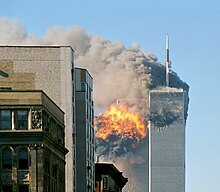
The
demand for terrorism insurance surged
after 9/11
Terrorism
insurance provides protection against
any loss or damage caused by terrorist
activities. In the US in the wake of
9/11,
the Terrorism
Risk Insurance Act 2002 (TRIA) set
up a federal Program providing a transparent
system of shared public and private
compensation for insured losses resulting
from acts of terrorism. The program
was extended until the end of 2014 by
the Terrorism Risk Insurance Program
Reauthorization Act 2007 (TRIPRA).
Volcano
insurance is a specialized insurance
protecting against damage arising specifically
from volcanic eruptions.
Windstorm
insurance is an insurance covering the
damage that can be caused by wind events
such as hurricanes.
Liability
insurance is a very broad superset that
covers legal claims against the insured.
Many types of insurance include an aspect
of liability coverage. For example, a
homeowner's insurance policy will normally
include liability coverage which protects
the insured in the event of a claim brought
by someone who slips and falls on the
property; automobile insurance also includes
an aspect of liability insurance that
indemnifies against the harm that a crashing
car can cause to others' lives, health,
or property. The protection offered by
a liability insurance policy is twofold:
a legal defense in the event of a lawsuit
commenced against the policyholder and
indemnification (payment on behalf of
the insured) with respect to a settlement
or court verdict. Liability policies typically
cover only the negligence of the insured,
and will not apply to results of wilful
or intentional acts by the insured.
Public
liability insurance covers a business
or organization against claims should
its operations injure a member of the
public or damage their property in some
way.
Directors
and officers liability insurance
(D&O) protects an organization (usually
a corporation) from costs associated
with litigation resulting from errors
made by directors and officers for which
they are liable.
Environmental
liability insurance protects the insured
from bodily injury, property damage
and cleanup costs as a result of the
dispersal, release or escape of pollutants.
Errors
and omissions insurance (E&O)
is business liability insurance for
professionals such as insurance agents,
real estate agents and brokers, architects,
third-party administrators (TPAs) and
other business professionals.
Prize
indemnity insurance protects the
insured from giving away a large prize
at a specific event. Examples would
include offering prizes to contestants
who can make a half-court shot at a
basketball
game, or a hole-in-one
at a golf tournament.
Professional
liability insurance, also called
professional
indemnity insurance (PI), protects
insured professionals such as architectural
corporations and medical practitioners
against potential negligence claims
made by their patients/clients. Professional
liability insurance may take on different
names depending on the profession. For
example, professional liability insurance
in reference to the medical profession
may be called medical
malpractice insurance.
Credit
insurance repays some or all of a loan
when certain circumstances arise to the
borrower such as unemployment,
disability,
or death.
Mortgage
insurance insures the lender against
default by the borrower. Mortgage insurance
is a form of credit insurance, although
the name "credit insurance" more often
is used to refer to policies that cover
other kinds of debt.
Many
credit cards offer payment protection
plans which are a form of credit insurance.
Trade
credit insurance is business insurance
over the accounts receivable of the
insured. The policy pays the policy
holder for covered accounts receivable
if the debtor defaults on payment.
Other
types
All-risk
insurance is an insurance that covers
a wide range of incidents and perils,
except those noted in the policy. All-risk
insurance is different from peril-specific
insurance that cover losses from only
those perils listed in the policy. In
car
insurance, all-risk policy includes
also the damages caused by the own driver.
High-value
horses may be insured under a bloodstock
policy
Bloodstock
insurance covers individual horses
or a number of horses under common ownership.
Coverage is typically for mortality
as a result of accident, illness or
disease but may extend to include infertility,
in-transit loss, veterinary fees, and
prospective foal.
Business
interruption insurance covers the
loss of income, and the expenses incurred,
after a covered peril interrupts normal
business operations.
Collateral
protection insurance (CPI) insures
property (primarily vehicles) held as
collateral for loans made by lending
institutions.
Defense
Base Act (DBA) insurance provides
coverage for civilian workers hired
by the government to perform contracts
outside the US and Canada. DBA is required
for all US citizens, US residents, US
Green Card holders, and all employees
or subcontractors hired on overseas
government contracts. Depending on the
country, foreign nationals must also
be covered under DBA. This coverage
typically includes expenses related
to medical treatment and loss of wages,
as well as disability and death benefits.
Expatriate
insurance provides individuals and
organizations operating outside of their
home country with protection for automobiles,
property, health, liability and business
pursuits.
Kidnap
and ransom insurance is designed
to protect individuals and corporations
operating in high-risk areas around
the world against the perils of kidnap,
extortion, wrongful detention and hijacking.
Legal
expenses insurance covers policyholders
for the potential costs of legal action
against an institution or an individual.
When something happens which triggers
the need for legal action, it is known
as "the event". There are two main types
of legal expenses insurance: before
the event insurance and after
the event insurance.
Livestock
insurance is a specialist policy provided
to, for example, commercial or hobby
farms, aquariums, fish farms or any
other animal holding. Cover is available
for mortality or economic slaughter
as a result of accident, illness or
disease but can extend to include destruction
by government order.
Media
liability insurance is designed to cover
professionals that engage in film and
television production and print, against
risks such as defamation.
Pet
insurance insures pets against accidents
and illnesses; some companies cover
routine/wellness care and burial, as
well.
Pollution
insurance usually takes the form of
first-party coverage for contamination
of insured property either by external
or on-site sources. Coverage is also
afforded for liability to third parties
arising from contamination of air, water,
or land due to the sudden and accidental
release of hazardous materials from
the insured site. The policy usually
covers the costs of cleanup and may
include coverage for releases from underground
storage tanks. Intentional acts are
specifically excluded.
Purchase
insurance is aimed at providing protection
on the products people purchase. Purchase
insurance can cover individual purchase
protection, warranties,
guarantees,
care plans and even mobile phone insurance.
Such insurance is normally very limited
in the scope of problems that are covered
by the policy.
Title
insurance provides a guarantee that
title to real
property is vested in the purchaser
and/or mortgagee,
free and clear of liens
or encumbrances. It is usually issued
in conjunction with a search of the
public records performed at the time
of a real estate
transaction.
Travel
insurance is an insurance cover
taken by those who travel abroad, which
covers certain losses such as medical
expenses, loss of personal belongings,
travel delay, and personal liabilities.
Tuition
insurance insures students against
involuntary withdrawal from cost-intensive
educational institutions
Interest
rate insurance protects the holder
from adverse changes in interest rates,
for instance for those with a variable
rate loan or mortgage
Insurance
financing vehicles
Fraternal
insurance is provided on a cooperative
basis by fraternal
benefit societies or other social
organizations.
No-fault
insurance is a type of insurance
policy (typically automobile insurance)
where insureds are indemnified by their
own insurer regardless of fault in the
incident.
Protected
self-insurance is an alternative risk
financing mechanism in which an organization
retains the mathematically calculated
cost of risk within the organization
and transfers the catastrophic risk
with specific and aggregate limits to
an insurer so the maximum total cost
of the program is known. A properly
designed and underwritten Protected
Self-Insurance Program reduces and stabilizes
the cost of insurance and provides valuable
risk management information.
Retrospectively
rated insurance is a method of establishing
a premium on large commercial accounts.
The final premium is based on the insured's
actual loss experience during the policy
term, sometimes subject to a minimum
and maximum premium, with the final
premium determined by a formula. Under
this plan, the current year's premium
is based partially (or wholly) on the
current year's losses, although the
premium adjustments may take months
or years beyond the current year's expiration
date. The rating formula is guaranteed
in the insurance contract. Formula:
retrospective premium = converted loss
+ basic premium x tax multiplier. Numerous
variations of this formula have been
developed and are in use.
Formal
self-insurance
is the deliberate decision to pay for
otherwise insurable losses out of one's
own money. This can
be done on a formal basis by establishing
a separate fund into which funds are
deposited on a periodic basis, or by
simply forgoing the purchase of available
insurance and paying out-of-pocket.
Self-insurance is usually used to pay
for high-frequency, low-severity losses.
Such losses, if covered by conventional
insurance, mean having to pay a premium
that includes loadings for the company's
general expenses, cost of putting the
policy on the books, acquisition expenses,
premium taxes, and contingencies. While
this is true for all insurance, for
small, frequent losses the transaction
costs may exceed the benefit of volatility
reduction that insurance otherwise affords.
Reinsurance
is a type of insurance purchased by
insurance companies or self-insured
employers to protect against unexpected
losses. Financial
reinsurance is a form of reinsurance
that is primarily used for capital management
rather than to transfer insurance risk.
Social
insurance can be many things to
many people in many countries. But a
summary of its essence is that it is
a collection of insurance coverages
(including components of life insurance,
disability income insurance, unemployment
insurance, health insurance, and others),
plus retirement savings, that requires
participation by all citizens. By forcing
everyone in society to be a policyholder
and pay premiums, it ensures that everyone
can become a claimant when or if he/she
needs to. Along the way this inevitably
becomes related to other concepts such
as the justice system and the welfare
state. This is a large, complicated
topic that engenders tremendous debate,
which can be further studied in the
following articles (and others):
Stop-loss
insurance provides protection against
catastrophic or unpredictable losses.
It is purchased by organizations who
do not want to assume 100% of the liability
for losses arising from the plans. Under
a stop-loss policy, the insurance company
becomes liable for losses that exceed
certain limits called deductibles.
Closed
community self-insurance
Some
communities prefer to create virtual insurance
amongst themselves by other means than
contractual risk transfer, which assigns
explicit numerical values to risk. A number
of religious
groups, including the Amish
and some Muslim
groups, depend on support provided by
their communities
when disasters
strike. The risk presented by any given
person is assumed collectively by the
community who all bear the cost of rebuilding
lost property and supporting people whose
needs are suddenly greater after a loss
of some kind. In supportive communities
where others can be trusted to follow
community leaders, this tacit form of
insurance can work. In this manner the
community can even out the extreme differences
in insurability that exist among its members.
Some further justification is also provided
by invoking the moral
hazard of explicit insurance contracts.
In
the United
Kingdom, The
Crown (which, for practical purposes,
meant the civil
service) did not insure property such
as government buildings. If a government
building was damaged, the cost of repair
would be met from public funds because,
in the long run, this was cheaper than
paying insurance premiums. Since many
UK government buildings have been sold
to property companies, and rented back,
this arrangement is now less common and
may have disappeared altogether.
Insurance
companies
Insurance
companies may be classified into two groups:
Life
insurance companies, which sell life
insurance, annuities and pensions products.
Non-life,
general, or property/casualty insurance
companies, which sell other types of
insurance.
General
insurance companies can be further divided
into these sub categories.
Standard
lines
Excess
lines
In
most countries, life and non-life insurers
are subject to different regulatory regimes
and different tax
and accounting
rules. The main reason for the distinction
between the two types of company is that
life, annuity, and pension business is
very long-term in nature - coverage for
life assurance or a pension can cover
risks over many decades.
By contrast, non-life insurance cover
usually covers a shorter period, such
as one year.
In
the United States, standard line insurance
companies are insurers that have received
a license or authorization from a state
for the purpose of writing specific kinds
of insurance in that state, such as automobile
insurance or homeowners' insurance. They
are typically referred to as "admitted"
insurers. Generally, such an insurance
company must submit its rates and policy
forms to the state's insurance regulator
to receive his or her prior approval,
although whether an insurance company
must receive prior approval depends upon
the kind of insurance being written. Standard
line insurance companies usually charge
lower premiums than excess line insurers
and may sell directly to individual insureds.
They are regulated by state laws, which
include restrictions on rates and forms,
and which aim to protect consumers and
the public from unfair or abusive practices.
These insurers also are required to contribute
to state guarantee funds, which are used
to pay for losses if an insurer becomes
insolvent.
Excess
line insurance companies (also known as
Excess and Surplus) typically insure risks
not covered by the standard lines insurance
market, due to a variety of reasons (e.g.,
new entity or an entity that does not
have an adequate loss history, an entity
with unique risk characteristics, or an
entity that has a loss history that does
not fit the underwriting requirements
of the standard lines insurance market).
They are typically referred to as non-admitted
or unlicensed insurers. Non-admitted insurers
are generally not licensed or authorized
in the states in which they write business,
although they must be licensed or authorized
in the state in which they are domiciled.
These companies have more flexibility
and can react faster than standard line
insurance companies because they are not
required to file rates and forms. However,
they still have substantial regulatory
requirements placed upon them.
Most
states require that excess line insurers
submit financial information, articles
of incorporation, a list of officers,
and other general information. They also
may not write insurance that is typically
available in the admitted market, do not
participate in state guarantee funds (and
therefore policyholders do not have any
recourse through these funds if an insurer
becomes insolvent and cannot pay claims),
may pay higher taxes, only may write coverage
for a risk if it has been rejected by
three different admitted insurers, and
only when the insurance producer placing
the business has a surplus lines license.
Generally, when an excess line insurer
writes a policy, it must, pursuant to
state laws, provide disclosure to the
policyholder that the policyholder's policy
is being written by an excess line insurer.
Insurance
companies are generally classified as
either mutual
or proprietary companies. Mutual companies
are owned by the policyholders, while
shareholders (who may or may not own policies)
own proprietary insurance companies.
Demutualization
of mutual insurers to form stock companies,
as well as the formation of a hybrid known
as a mutual holding company, became common
in some countries, such as the United
States, in the late 20th century. However,
not all states permit mutual holding companies.
Other
possible forms for an insurance company
include reciprocals,
in which policyholders reciprocate in
sharing risks, and Lloyd's organizations.
Insurance
companies are rated by various agencies
such as A. M. Best.
The ratings include the company's financial
strength, which measures its ability to
pay claims. It also rates financial instruments
issued by the insurance company, such
as bonds, notes, and securitization products.
Reinsurance
companies are insurance companies that
sell policies to other insurance companies,
allowing them to reduce their risks and
protect themselves from very large losses.
The reinsurance market is dominated by
a few very large companies, with huge
reserves. A reinsurer may also be a direct
writer of insurance risks as well.
Captive
insurance companies may be defined
as limited-purpose insurance companies
established with the specific objective
of financing risks emanating from their
parent group or groups. This definition
can sometimes be extended to include some
of the risks of the parent company's customers.
In short, it is an in-house self-insurance
vehicle. Captives may take the form of
a "pure" entity (which is a 100% subsidiary
of the self-insured parent company); of
a "mutual" captive (which insures the
collective risks of members of an industry);
and of an "association" captive (which
self-insures individual risks of the members
of a professional, commercial or industrial
association). Captives represent commercial,
economic and tax advantages to their sponsors
because of the reductions in costs they
help create and for the ease of insurance
risk management and the flexibility for
cash flows they generate. Additionally,
they may provide coverage of risks which
is neither available nor offered in the
traditional insurance market at reasonable
prices.
The
types of risk that a captive can underwrite
for their parents include property damage,
public and product liability, professional
indemnity, employee benefits, employers'
liability, motor and medical aid expenses.
The captive's exposure to such risks may
be limited by the use of reinsurance.
Captives
are becoming an increasingly important
component of the risk management and risk
financing strategy of their parent. This
can be understood against the following
background:
heavy
and increasing premium costs in almost
every line of coverage;
difficulties
in insuring certain types of fortuitous
risk;
differential
coverage standards in various parts
of the world;
rating
structures which reflect market trends
rather than individual loss experience;
insufficient
credit for deductibles and/or loss control
efforts.
There
are also companies known as 'insurance
consultants'. Like a mortgage broker,
these companies are paid a fee by the
customer to shop around for the best insurance
policy amongst many companies. Similar
to an insurance consultant, an 'insurance
broker' also shops around for the best
insurance policy amongst many companies.
However, with insurance brokers, the fee
is usually paid in the form of commission
from the insurer that is selected rather
than directly from the client.
Neither
insurance consultants nor insurance brokers
are insurance companies and no risks are
transferred to them in insurance transactions.
Third party administrators are companies
that perform underwriting and sometimes
claims handling services for insurance
companies. These companies often have
special expertise that the insurance companies
do not have.
The
financial stability and strength of an
insurance company should be a major consideration
when buying an insurance contract. An
insurance premium paid currently provides
coverage for losses that might arise many
years in the future. For that reason,
the viability of the insurance carrier
is very important. In recent years, a
number of insurance companies have become
insolvent, leaving their policyholders
with no coverage (or coverage only from
a government-backed insurance pool or
other arrangement with less attractive
payouts for losses). A number of independent
rating agencies provide information and
rate the financial viability of insurance
companies.
Across
the world
Life
insurance premiums written in 2005
Non-life
insurance premiums written in 2005
Global
insurance premiums grew by 2.7% in inflation-adjusted
terms in 2010 to $4.3 trillion, climbing
above pre-crisis levels. The return to
growth and record premiums generated during
the year followed two years of decline
in real terms. Life insurance premiums
increased by 3.2% in 2010 and non-life
premiums by 2.1%. While industrialised
countries saw an increase in premiums
of around 1.4%, insurance markets in emerging
economies saw rapid expansion with 11%
growth in premium income. The global insurance
industry was sufficiently capitalised
to withstand the financial crisis of 2008
and 2009 and most insurance companies
restored their capital to pre-crisis levels
by the end of 2010. With the continuation
of the gradual recovery of the global
economy, it is likely the insurance industry
will continue to see growth in premium
income both in industrialised countries
and emerging markets in 2011.
Advanced
economies account for the bulk of global
insurance. With premium income of $1,620bn,
Europe was the most important region in
2010, followed by North America $1,409bn
and Asia $1,161bn. Europe has however
seen a decline in premium income during
the year in contrast to the growth seen
in North America and Asia. The top four
countries generated more than a half of
premiums. The US and Japan alone accounted
for 40% of world insurance, much higher
than their 7% share of the global population.
Emerging economies accounted for over
85% of the world's population but only
around 15% of premiums. Their markets
are however growing at a quicker pace.
The country expected to have the biggest
impact on the insurance share distribution
across the world is China. According to
Sam Radwan
of Enhance International, low premium
penetration (insurance premium as a %
of GDP), an ageing population and the
largest car market in terms of new sales,
premium growth has averaged 15-20% in
the past five years, and China is expected
to be the largest insurance market in
the next decade or two.
In
the United States, insurance is regulated
by the states under the McCarran-Ferguson
Act, with "periodic proposals for
federal intervention", and a nonprofit
coalition of state insurance agencies
called the National
Association of Insurance Commissioners
works to harmonize the country's different
laws and regulations. The National Conference
of Insurance Legislators (NCOIL) also
works to harmonize the different state
laws.
In
the European
Union, the Third Non-Life Directive
and the Third Life Directive, both passed
in 1992 and effective 1994, created a
single insurance market in Europe and
allowed insurance companies to offer insurance
anywhere in the EU (subject to permission
from authority in the head office) and
allowed insurance consumers to purchase
insurance from any insurer in the EU.
As far as insurance
in the United Kingdom, the Financial
Services Authority took over insurance
regulation from the General Insurance
Standards Council in 2005; laws passed
include the Insurance Companies Act 1973
and another in 1982, and reforms to warranty
and other aspects under discussion as
of 2012.
The
insurance
industry in China was nationalized
in 1949 and thereafter offered by only
a single state-owned company, the People's
Insurance Company of China, which
was eventually suspended as demand declined
in a communist environment. In 1978, market
reforms led to an increase in the market
and by 1995 a comprehensive Insurance
Law of the People's Republic of China
was passed, followed in 1998 by the formation
of China
Insurance Regulatory Commission (CIRC),
which has broad regulatory authority over
the insurance market of China.
In
India, IRDA is insurance regulatory authority.
As per the section 4 of IRDA Act' 1999,
Insurance Regulatory and Development Authority
(IRDA), which was constituted by an act
of parliament. National Insurance Academy,
Pune is apex insurance capacity builder
institute promoted with support from Ministry
of Finance and by LIC, Life & General
Insurance companies.
Controversies
Insurance
insulates too much
An
insurance company may inadvertently find
that its insureds may not be as risk-averse
as they might otherwise be (since, by
definition, the insured has transferred
the risk to the insurer), a concept known
as moral hazard.
To reduce their own financial exposure,
insurance companies have contractual clauses
that mitigate their obligation to provide
coverage if the insured engages in behavior
that grossly magnifies their risk of loss
or liability.
For
example, life insurance companies may
require higher premiums or deny coverage
altogether to people who work in hazardous
occupations or engage in dangerous sports.
Liability insurance providers do not provide
coverage for liability arising from intentional
torts committed by or at the direction
of the insured. Even if a provider were
so irrational as to want to provide such
coverage, it is against the public policy
of most countries to allow such insurance
to exist, and thus it is usually illegal.
Complexity
of insurance policy contracts
9/11
was a major insurance loss, but there
were disputes over the World
Trade Center's insurance policy
Insurance
policies can be complex and some policyholders
may not understand all the fees and coverages
included in a policy. As a result, people
may buy policies on unfavorable terms.
In response to these issues, many countries
have enacted detailed statutory and regulatory
regimes governing every aspect of the
insurance business, including minimum
standards for policies and the ways in
which they may be advertised
and sold.
For
example, most insurance policies in the
English language today have been carefully
drafted in plain
English; the industry learned the
hard way that many courts will not enforce
policies against insureds when the judges
themselves cannot understand what the
policies are saying. Typically, courts
construe ambiguities in insurance policies
against the insurance company and in favor
of coverage under the policy.
Many
institutional insurance purchasers buy
insurance through an insurance broker.
While on the surface it appears the broker
represents the buyer (not the insurance
company), and typically counsels the buyer
on appropriate coverage and policy limitations,
in the vast majority of cases a broker's
compensation comes in the form of a commission
as a percentage of the insurance premium,
creating a conflict of interest in that
the broker's financial interest is tilted
towards encouraging an insured to purchase
more insurance than might be necessary
at a higher price. A broker generally
holds contracts with many insurers, thereby
allowing the broker to "shop" the market
for the best rates and coverage possible.
Insurance
may also be purchased through an agent.
A tied agent, working exclusively with
one insurer, represents the insurance
company from whom the policyholder buys
(while a free agent sales policies of
various insurance companies). Just as
there is a potential conflict of interest
with a broker, an agent has a different
type of conflict. Because agents work
directly for the insurance company, if
there is a claim the agent may advise
the client to the benefit of the insurance
company. Agents generally cannot offer
as broad a range of selection compared
to an insurance broker.
An
independent insurance consultant advises
insureds on a fee-for-service retainer,
similar to an attorney, and thus offers
completely independent advice, free of
the financial conflict of interest of
brokers and/or agents. However, such a
consultant must still work through brokers
and/or agents in order to secure coverage
for their clients.
Limited
consumer benefits
In
United States, economists and consumer
advocates generally consider insurance
to be worthwhile for low-probability,
catastrophic losses, but not for high-probability,
small losses. Because of this, consumers
are advised to select high deductibles
and to not insure losses which would not
cause a disruption in their life. However,
consumers have shown a tendency to prefer
low deductibles and to prefer to insure
relatively high-probability, small losses
over low-probability, perhaps due to not
understanding or ignoring the low-probability
risk. This is associated with reduced
purchasing of insurance against low-probability
losses, and may result in increased inefficiencies
from moral hazard.
Redlining
Redlining
is the practice of denying insurance coverage
in specific geographic areas, supposedly
because of a high likelihood of loss,
while the alleged motivation is unlawful
discrimination. Racial
profiling or redlining
has a long history in the property insurance
industry in the United States. From a
review of industry underwriting and marketing
materials, court documents, and research
by government agencies, industry and community
groups, and academics, it is clear that
race has long affected and continues to
affect the policies and practices of the
insurance industry.
In
July, 2007, The Federal Trade Commission
(FTC) released a report presenting the
results of a study concerning credit-based
insurance
scores in automobile insurance. The
study found that these scores are effective
predictors of risk. It also showed that
African-Americans and Hispanics are substantially
overrepresented in the lowest credit scores,
and substantially underrepresented in
the highest, while Caucasians and Asians
are more evenly spread across the scores.
The credit scores were also found to predict
risk within each of the ethnic groups,
leading the FTC to conclude that the scoring
models are not solely proxies for redlining.
The FTC indicated little data was available
to evaluate benefit of insurance scores
to consumers. The report was disputed
by representatives of the Consumer Federation
of America, the National Fair Housing
Alliance, the National Consumer Law Center,
and the Center for Economic Justice, for
relying on data provided by the insurance
industry.
All
states have provisions in their rate regulation
laws or in their fair trade practice acts
that prohibit unfair discrimination, often
called redlining, in setting rates and
making insurance available.
In
determining premiums and premium rate
structures, insurers consider quantifiable
factors, including location, credit
scores, gender,
occupation,
marital status,
and education
level. However, the use of such factors
is often considered to be unfair or unlawfully
discriminatory,
and the reaction against this practice
has in some instances led to political
disputes about the ways in which insurers
determine premiums and regulatory intervention
to limit the factors used.
An
insurance underwriter's job is to evaluate
a given risk as to the likelihood that
a loss will occur. Any factor that causes
a greater likelihood of loss should theoretically
be charged a higher rate. This basic principle
of insurance must be followed if insurance
companies are to remain solvent. Thus, "discrimination"
against (i.e., negative differential treatment
of) potential insureds in the risk evaluation
and premium-setting process is a necessary
by-product of the fundamentals of insurance
underwriting. For instance, insurers charge
older people significantly higher premiums
than they charge younger people for term
life insurance. Older people are thus
treated differently than younger people
(i.e., a distinction is made, discrimination
occurs). The rationale for the differential
treatment goes to the heart of the risk
a life insurer takes: Old people are likely
to die sooner than young people, so the
risk of loss (the insured's death) is
greater in any given period of time and
therefore the risk
premium must be higher to cover the
greater risk. However, treating insureds
differently when there is no actuarially
sound reason for doing so is unlawful
discrimination.
What
is often missing from the debate is that
prohibiting the use of legitimate, actuarially
sound factors means that an insufficient
amount is being charged for a given risk,
and there is thus a deficit in the system. The failure
to address the deficit may mean insolvency
and hardship for all of a company's insureds. The options
for addressing the deficit seem to be
the following: Charge the deficit to the
other policyholders or charge it to the
government (i.e., externalize outside
of the company to society at large).
Many
independent inventors are in favor of
patenting new insurance products since
it gives them protection from big companies
when they bring their new insurance products
to market. Independent inventors account
for 70% of the new US patent applications
in this area.
Many
insurance executives are opposed to patenting
insurance products because it creates
a new risk for them. The
Hartford insurance company, for example,
recently had to pay $80 million to an
independent inventor, Bancorp Services,
in order to settle a patent infringement
and theft of trade secret lawsuit for
a type of corporate owned life insurance
product invented and patented by Bancorp.
There
are currently about 150 new patent applications
on insurance inventions filed per year
in the United States. The rate at which
patents have been issued has steadily
risen from 15 in 2002 to 44 in 2006.
Inventors
can now have their insurance US patent
applications reviewed by the public in
the Peer to
Patent program. The first insurance
patent application to be posted was US2009005522
"Risk assessment company". It was
posted on March 6, 2009. This patent application
describes a method for increasing the
ease of changing insurance companies.
The
insurance industry and rent-seeking
Certain
insurance products and practices have
been described as rent-seeking
by critics. That is,
some insurance products or practices are
useful primarily because of legal benefits,
such as reducing taxes, as opposed to
providing protection against risks of
adverse events. Under United States tax
law, for example, most owners of variable
annuities and variable
life insurance can invest their premium
payments in the stock market and defer
or eliminate paying any taxes on their
investments until withdrawals are made.
Sometimes this tax deferral is the only
reason people use these products. Another example
is the legal infrastructure which allows
life insurance to be held in an irrevocable
trust which is used to pay an estate
tax while the proceeds themselves
are immune from the estate tax.
Orange
County
is a county in Southern California, United States.
Its county seat is Santa Ana. According to the 2000
Census, its population was 2,846,289, making it
the second most populous county in the state of
California, and the fifth most populous in the United
States. The state of California estimates its population
as of 2007 to be 3,098,121 people, dropping its
rank to third, behind San Diego County. Thirty-four
incorporated cities are located in Orange County;
the newest is Aliso Viejo.
Unlike many other large centers of population in
the United States, Orange County uses its county
name as its source of identification whereas other
places in the country are identified by the large
city that is closest to them. This is because there
is no defined center to Orange County like there
is in other areas which have one distinct large
city. Five Orange County cities have populations
exceeding 170,000 while no cities in the county
have populations surpassing 360,000. Seven of these
cities are among the 200 largest cities in the United
States.
Orange County is also famous as a tourist destination,
as the county is home to such attractions as Disneyland
and Knott's Berry Farm, as well as sandy beaches
for swimming and surfing, yacht harbors for sailing
and pleasure boating, and extensive area devoted
to parks and open space for golf, tennis, hiking,
kayaking, cycling, skateboarding, and other outdoor
recreation. It is at the center of Southern California's
Tech Coast, with Irvine being the primary business
hub.
The average price of a home in Orange County is
$541,000. Orange County is the home of a vast number
of major industries and service organizations. As
an integral part of the second largest market in
America, this highly diversified region has become
a Mecca for talented individuals in virtually every
field imaginable. Indeed the colorful pageant of
human history continues to unfold here; for perhaps
in no other place on earth is there an environment
more conducive to innovative thinking, creativity
and growth than this exciting, sun bathed valley
stretching between the mountains and the sea in
Orange County.
Orange County was Created March 11 1889, from part
of Los Angeles County, and, according to tradition,
so named because of the flourishing orange culture.
Orange, however, was and is a commonplace name in
the United States, used originally in honor of the
Prince of Orange, son-in-law of King George II of
England.
Incorporated:
March 11, 1889 Legislative Districts:
* Congressional: 38th-40th, 42nd & 43
* California Senate: 31st-33rd, 35th & 37
* California Assembly: 58th, 64th, 67th, 69th,
72nd & 74
County Seat: Santa Ana County Information:
Robert E. Thomas Hall of Administration
10 Civic Center Plaza, 3rd Floor, Santa Ana
92701 Telephone: (714)834-2345 Fax: (714)834-3098
County Government Website:http://www.oc.ca.gov
Noteworthy
communities Some of the communities that exist within
city limits are listed below:
* Anaheim Hills, Anaheim * Balboa Island, Newport
Beach * Corona del Mar, Newport Beach * Crystal
Cove / Pelican Hill, Newport Beach * Capistrano
Beach, Dana Point * El Modena, Orange * French Park,
Santa Ana * Floral Park, Santa Ana * Foothill Ranch,
Lake Forest * Monarch Beach, Dana Point * Nellie
Gail, Laguna Hills * Northwood, Irvine * Woodbridge,
Irvine * Newport Coast, Newport Beach * Olive, Orange
* Portola Hills, Lake Forest * San Joaquin Hills,
Laguna Niguel * San Joaquin Hills, Newport Beach
* Santa Ana Heights, Newport Beach * Tustin Ranch,
Tustin * Talega, San Clemente * West Garden Grove,
Garden Grove * Yorba Hills, Yorba Linda * Mesa Verde,
Costa Mesa
Unincorporated communities These communities
are outside of the city limits in unincorporated
county territory: * Coto de Caza * El Modena
* Ladera Ranch * Las Flores * Midway City * Orange
Park Acres * Rossmoor * Silverado Canyon * Sunset
Beach * Surfside * Trabuco Canyon * Tustin Foothills
Adjacent counties to Orange County Are: *
Los Angeles County, California - north, west * San
Bernardino County, California - northeast * Riverside
County, California - east * San Diego County, California
- southeast
"An
honest answer is the sign of true friendship."
We
receive many customers from across the world including
people from the following cities:
Aliso
Viejo 92656, 92698, Anaheim 92801, 92802, 92803, 92804,
92805, 92806, 92807, 92808, 92809, 92812, 92814, 92815,
92816, 92817, 92825, 92850, 92899, Atwood, 92811,
Brea, 92821, 92822,92823, Buena Park, 90620 ,90621,90622,
90624, Capistrano Beach, 92624, Corona del Mar, 92625,
Costa Mesa, 92626, 92627, 92628, Cypress, 90630, Dana
Point, 92629, East Irvine, 92650, El Toro, 92609,
Foothill Ranch, 92610, Fountain Valley, 92708, 92728,
Fullerton, 92831, 92832, 92833, 92834, 92835, 92836,
92837, 92838, Garden Grove, 92840, 92841, 92842, 92843
,92844, 92845, 92846, Huntington Beach , 92605, 92615,
92646, 92647, 92648, 92649, Irvine, 92602, 92603,
92604, 92606, 92612, 92614, 92616, 92617, 92618, 92619,
92620, 92623, 92697, La Habra, 90631, 90632, 90633,
La Palma, 90623, Ladera Ranch, 92694, Laguna Beach
, 92651, 92652, Laguna Hills ,92653, 92654,92607,92677,
Laguna Woods, 92637, Lake Forest, 92630, Los Alamitos,
90720, 90721, Midway City, 92655, Mission Viejo, 92690,
92691, 92692,Newport Beach , 92658, 92659, 92660,
92661, 92662, 92663, 92657,
Orange, 92856, 92857, 92859, 92862, 92863, 92864,
92865, 92866, 92867, 92868, 92869, Placentia, 92870,
92871, Rancho Santa Margarita 92688, San Clemente,
92672, 92673, 92674, San Juan Capistrano, 92675, 92693,
Santa Ana , 92701, 92702, 92703, 92704, 92705 ,92706,
92707, 92711, 92712, 92725.92735, 92799, Seal Beach
, 90740, Silverado 92676, Stanton, 90680, Sunset Beach
90742, Surfside 90743, Trabuco Canyon, 92678, 92679,Tustin
,92780, 92781,92782, Villa Park, 92861,Westminster,
92683, 92684, 92685, Yorba Linda, 92885, 92886, 92887
This
Institution was Awarded
Best Value in Insurance
Orange County CA, Visit:
OrangeCountyCABusinessDirectory.com
Aylor Insurance Agency, Inc.
Call (949) 581-2333
�
2013 Aylor Insurance Agency, Inc., 22691 Lambert Street,
Suite 505, Lake Forest, California 92630
Auto Insurance, Home Insurance, Commercial
Property Insurance, Fleet Insurance, Commercial Auto Insurance,
Professional Liability Insurance, Directors and Officers
Umbrella Insurance, Bonding (Fidelity/Surety) Insurance,
Air and Ocean Cargo Insurance, Inland Marine InsuranceCommercial
Liability Insurance, Boat, Yacht Insurance, Builder's Risk
Insurance, Boiler and Machinery Insurance, Commercial Packages
Insurance, Workers' Compensation Insurance, Flood Insurance,
Small, Medium, Large Business Insurance, Life Insurance,
Term Life Insurance, Whole Life Insurance, Universal Life
Insurance, Mortgage Protection Insurance, Estate Liquidity
Insurance, Health Insurance, Individual Health Insurance,
HSA's Insurance, Employee Group Benefits Insurance, Dental
Insurance, Long Term Care Insurance, Nursing Home Insurance,
Home Health Insurance, Assisted Living Care Insurance, Supplemental
Insurance, Accident Insurance, Cancer Insurance, Intensive
Care Insurance, Catastrophic Illness Insurance, Disability
Income Insurance, Retirement Planning, Annuities, IRA Plans,
Traditional IRAs, Roth IRAs, Capital Needs Analysis Pension
Plans, 401K, Retirement, Buy/Sell Funding, Key-Person Insurance,
Split Dollar Insurance, Reverse Split Dollar Insurance,
Salary Continuation Insurance, Motorcycles Insurance, Personal
Liability Insurance, Personal Umbrella Insurance, Personal
Watercraft Insurance, Recreational Vehicles Insurance, Renters
Insurance, Tenant Dwellings Insurance, Earthquake Insurance,
Auto Insurace, Home Insurance, Home and auto insurance,
car insurance, Automobile Insurance, Builders Risk Insurance,
Farm and Ranch Insurance, Homeowners Insurance, Fine Arts
Insurance, Furs Insurance, Jewelry Insurance, Mobilehomes
Insurance, Allison Insurance 21st Century Insurance Aetna
Aflac Alleghany Corporation Allied Insurance Allstate American
Automobile Association American Family Insurance American
Income Life Insurance Company American International Group
(AIG) American National Insurance Company American United
Life Insurance Company Ameritas Life Insurance Company Amica
Mutual Insurance Assurant Auto-Owners Insurance AXA Equitable
Life Insurance Company Bankers Life and Casualty Company
Berkshire Hathaway California Casualty Cincinnati Insurance
Company CNA Financial Colonial Life & Accident Insurance
Company Commerce Insurance Group Conseco Country Financial
Chartis Chubb Corp. Direct General Auto Insurance Elephant.com
Encompass Insurance Company Erie Insurance Group Esurance
Evergreen USA RRG FM Global Farmers Insurance Group Federated
Mutual Insurance Company First Insurance Company of Hawaii,
LTD GAINSCO GEICO General Re Genworth Financial GMAC Insurance
Great West Casualty Company Gracy Title Company Guardian
Life Insurance Company of America GuideOne Insurance Hanover
Insurance The Hartford HCC Insurance Holdings Infinity Property
& Casualty Corporation IntelliQuote Insurance Services Jackson
National Life John Hancock Insurance K&K Insurance Kentucky
Farm Bureau Knights of Columbus Liberty Mutual Lincoln National
Corporation Markel Corporation MassMutual Financial Group
Merchants Insurance Group Mercury Insurance Group MetLife
Mutual of Omaha National Life Nationwide Mutual Insurance
Company New Jersey Manufacturers Insurance Company New York
Life Insurance Company Northwestern Mutual Ohio National
Financial Services Omega OneBeacon Oxford Health Plans Pacific
Life Pacificare PEMCO Penn Mutual Philadelphia Contributionship
for the Insurance of Houses from Loss by Fire Philadelphia
Insurance Companies Principal Financial Group Primerica
Financial Progressive Protective Life Prudential Financial
The Regence Group Reliance Insurance Company RLI Corp. Safe
Auto Insurance Company Safeco Safeway Insurance Group Sentry
Insurance Selective Insurance Shelter Insurance Southern
Aid and Insurance Company Standard Insurance Company Insurance Sun Life Financial Symetra TIAA-CREF The
Travelers Companies Trupanion Unitrin Direct Auto Insurance
Unum USAA West Coast Life Western Mutual Insurance Group
Western & Southern Financial Group Westfield Insurance White
Mountains Insurance Group AARP Aetna American Family Insurance
American National Insurance Company Amerigroup Anthem Blue
Cross and Blue Shield Assurant Blue Cross and Blue Shield
Association Centene Corporation Cigna Coventry Health Care
EmblemHealth Fortis Golden Rule Insurance Company Group
Health Cooperative GHI Health Net HealthMarkets HealthSpring
Highmark Humana Independence Blue Cross Kaiser Permanente
Kaleida Health LifeWise Health Plan of Oregon Medical Mutual
of Ohio Molina Healthcare Premera Blue Cross Principal Financial
Group The Regence Group Shelter Insurance Thrivent Financial
for Lutherans UnitedHealth Group Unitrin Universal American
Corporation WellCare Health Plans WellPoint Medicare Medicare
(United States) Aetna American Family Insurance Bankers
Life and Casualty Conseco Kaiser Permanente Mutual of Omaha
Premera Blue Cross Thrivent Financial for Lutherans Tricare
Aflac Allstate American Fidelity Assurance Assurant Colonial
Life & Accident Insurance Company Conseco Liberty National
Life Insurance Company MEGA Life and Health Insurance Mutual
of Omaha National Teachers Associates Life Insurance Company
Insurance Mondial Assistance Group Travel Guard
USA-ASSIST Worldwide Protection Assist Card Accident Fund
American International Group (AIG) BrickStreet Mutual Insurance
Cincinnati Financial Corporation Erie Insurance Group Hanover
Insurance The Hartford Liberty Mutual Merchants Insurance
Group Missouri Employers Mutual Nationwide Mutual Insurance
Company Penn National Insurance Republican Ideminity Co
Sentry Insurance State Accident Insurance Fund State Compensation
Insurance Fund Insurance WellPoint Zenith Insurance
Company, Aylor Insurance, Ed Aylor, Aylor Insurance Agency INSURANCE
ORANGE COUNTY, ORANGE COUNTY INSURANCE, INSURANCE QUOTE
ORANGE COUNTY CALIFORNIA
INSURANCE ORANGE COUNTY